Unit Conversion
μ
=
Friction coefficient
ET (Nm)
=
Total energy
P (bar)
=
Operating pressure
α (rad)
=
Inclination angle of bevel surface
ETC (Nm)
=
Total energy per hour
R (m)
=
Radius
θ (rad)
=
Impact contact travel angle
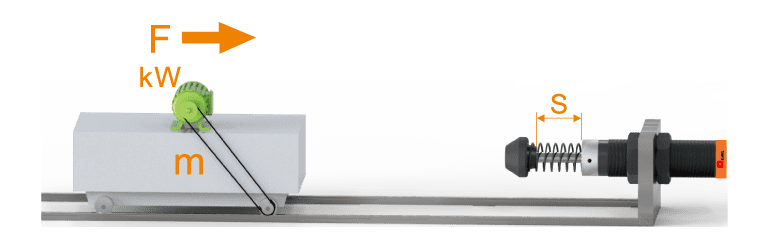
F (N)
=
Propulsion force
Rs (m)
=
Distance from hydraulic buffer to rotation center
ω (rad/s)
=
Angular velocity
Fm (N)
=
Maximum impact force
S (m)
=
Stroke
A (m)
=
Width
g (m/s2)
=
Gravitational acceleration
T (Nm)
=
Driving torque
B (m)
=
Thickness
h (m)
=
Height
t (s)
=
Deceleration time
C (/hr)
=
Impacts per hour
HM
=
Motor braking coefficient (usually 2.5)
v (m/s)
=
Instant impact velocity
d (mm)
=
Cylinder inner diameter
kW (kW)
=
Electric motor power
Vs (m/s)
=
Buffer impact velocity
ED (Nm)
=
Driving energy
m (kg)
=
Total weight of moving object
EK (Nm)
=
Kinetic energy
Me (kg)
=
Effective weight