

General Technology Co., Ltd. has achieved "dark factory" production in its domestic semi-steel radial tire plant, realizing 24-hour continuous production without lighting, reducing labor costs by 50%, improving production efficiency by 40%, and cutting labor costs by 20%. In terms of production and manufacturing, the digital infrastructure has been comprehensively improved, enhancing overall management and operational capabilities. With such substantial improvements in efficiency, how do hydraulic buffers play a role in this?
The realization of the "dark factory" relies on intelligent equipment such as EMS trolleys, robotic arms, and stacker cranes replacing manual production that requires lighting. Hydraulic buffers are often used on EMS trolleys to provide final shock absorption and cushioning, preventing damage to the EMS trolley in the event of a collision. Robotic arms are relatively common automation equipment on production lines. They can work together with production tools to manufacture products, increasing speed, precision, and production accuracy, reducing errors that might be caused by workers, and at the same time reducing labor costs. However, the high-speed, long-term operation of the equipment generates significant vibration and noise, damaging the machinery and reducing the safety performance of the equipment.
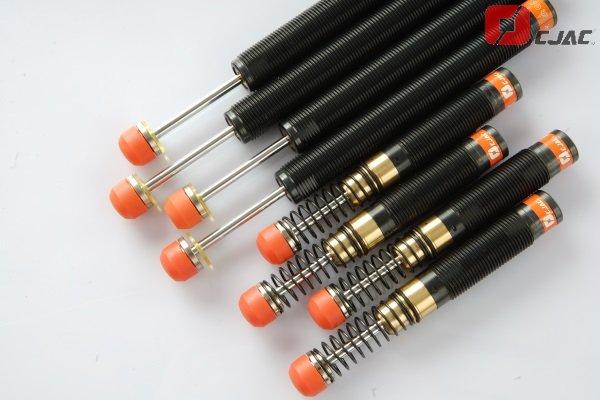
Robotic arms are generally equipped with hydraulic buffers to reduce the vibration generated during operation. The hydraulic damping effect of the buffer can absorb the impact energy generated by collisions during equipment operation and convert it into heat energy, thereby reducing damage caused by collisions. Hydraulic buffers can provide reliable and stable speed control for moving objects, ensuring more accurate robot operation and thus improving product quality.
In the future, General Technology Co., Ltd. will redefine manufacturing technology by integrating the three major aspects of "green," "intelligent," and "flexible," hoping to build a more competitive industrial chain ecosystem with the support of hydraulic buffers.